 By Daniel WhitmoreEditor-in-Chief
Agent-fee structures, warehouse consolidation, parcel forwarding, and customs documents for China-to-Europe shipments.
Goyard Bag Link Not Opening: How to Verify
When a [Goyard](https://fashion-reps.net/brand/goyard) bag link won't open, don't jump to conclusions based on a blank page, error page, or old screenshot that the item is no longer available, and don't immediately hunt for a similar-looking new link. Your task: confirm whether the current link still leads to a valid product page, determine if the problem is temporary loading, a link change, or insufficient product information, and then decide whether to keep verifying, ask the site for help, or
Editor score 4.2 / 5
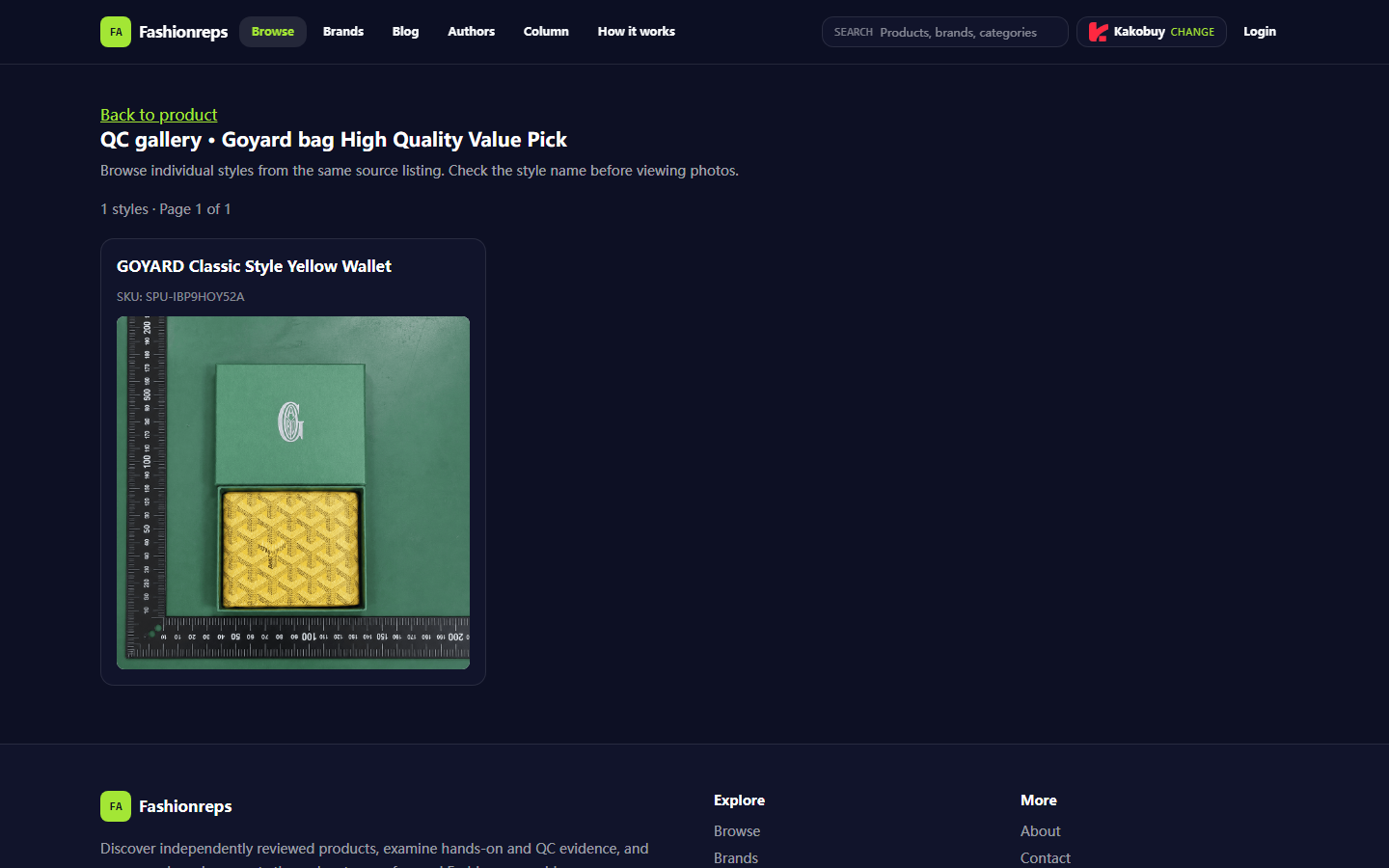
When a Goyard bag link won't open, don't jump to conclusions based on a blank page, error page, or old screenshot that the item is no longer available, and don't immediately hunt for a similar-looking new link. Your task: confirm whether the current link still leads to a valid product page, determine if the problem is temporary loading, a link change, or insufficient product information, and then decide whether to keep verifying, ask the site for help, or hold off on ordering. This article covers link verification only; it doesn't replace real-time confirmation of price, stock, size, material, seller, or after-sales policy.

Image caption: A page scenario used to illustrate re-checking product information from the catalog or QC entry.
Clarify the Goyard Bag Link Problem and Verification Goal
First, record the original information you have: the link, product title, source page, product category, color, size, seller fields, and the date you noticed the issue. Don't just save the link from your browser's address bar, and don't treat a shorthand name from a chat window as the official product name.
This verification should answer three questions:
- Does the original link still open a valid page showing a clear product name and visible product information?
- Does the opened page still correspond to the original Goyard bag, rather than a tag page, search results page, blank page, or another product?
- If the page can't be recovered, is there a reviewable catalog entry or site response to support the next step?
Price, stock, color, size, shipping, and return/exchange terms can all change. When recording, note the verification date, destination country, and shopping agent used; don't treat historical page content as a current promise.
Re-record the Product Title, Category, and Visible Link from the Catalog Entry
First, go back to the fashion-reps product catalog, brand page, or the corresponding QC entry, and use the product name and category to search for a candidate page. The catalog entry helps you determine if the old link just had a path change, but it doesn't automatically prove that two pages are the same product.
Re-record these fields:
- Product title: Keep the full name shown on the page, without adding model numbers or materials yourself.
- Product category: For example, wallet, tote, shoulder bag, or another category clearly marked on the page.
- Page address: Copy the complete current URL from your browser, and note whether a redirect occurred.
- Product identifier: If the page shows an SKU, style name, or other number, save it as well.
- Visible content: Note whether there are product images, sizes, colors, variants, seller info, and a QC entry.
- Page time: If the page shows an update or crawl time, record it as shown; if not, don't guess.
If the catalog has multiple similar Goyard pages, compare their titles, categories, style identifiers, and images one by one. Don't assume they're the same product just because the brand name matches. Link accessibility and whether the product itself is still purchasable are two separate issues that need separate verification.
Check Browser Messages, Redirects, Page Update Time, and Source Fields
Open the original link in a fresh browser session, first noting how the page actually behaves, then clear cache or switch networks and retry. Common situations and what they mean:
| Page Behavior | What You Can Initially Infer | What Else You Need to Check |
|---|---|---|
| Page shows 404 or a clear "doesn't exist" message | The original path may be dead | Whether there's a new path in the catalog, and whether the old product ID still matches |
| Page redirects to the brand page, search page, or catalog page | The link may have been migrated or the product recategorized | Whether the destination page has a clear product name, images, and specs |
| Page keeps loading blank, times out, or reloads repeatedly | Could be a temporary loading, network, or session issue | Whether a new session, different time, or another entry can open normally |
| Page opens but lacks specs, variants, or source fields | The page isn't necessarily dead, but information is insufficient | Whether there's reviewable product detail or QC info |
| Page shows a different product or unrelated category | The link may have been reused, incorrectly redirected, or recorded wrong | Whether the original title, SKU, images, and catalog entry match |
Don't call a single timeout a site failure. Only say there's a persistent access problem when multiple independent entries, different times, or an explicit site reply support that. Verification records should include specific dates, not vague descriptions like "it worked recently."
Compare Product Images, Sizes, Colors, and Variants for Consistency
If the catalog or QC page can open, compare the current information with your original records item by item. Images only help identify page content; they can't prove you've touched, tried, or purchased the product, nor can you judge material authenticity or actual quality by appearance alone.
Key checks:
- Do the bag's shape, structure, pattern placement, and hardware in the images match your original records?
- Are the color names shown on the page consistent? Avoid treating similar colors as the same variant.
- Are the length, width, height, capacity, or size descriptions still present, and have the units changed?
- Is the variant selector still usable, and does the default option mislead you into thinking all colors are in stock?
- Do the product title, SKU, source field, and QC entry point to the same page or same style?
When there's conflicting information, treat the fields currently displayed on the page as information to be verified, and keep the old record as historical evidence. Don't fill in missing specs using search result summaries, reposted images, or descriptions from other sellers.
Distinguish Temporary Loading Failure, Link Change, and Incomplete Information
Temporary loading failure usually means the same link recovers at a different time or in a different session, with the catalog entry and page content unchanged. In that case, you can retry later, but don't refresh so continuously that you can't judge the actual status, and don't create duplicate candidates in the agent shopping cart.
Link change usually means the original link doesn't open, but the catalog entry still has a matching title, category, product identifier, and visible content. Then save the old link, the new entry, and the comparison result, and confirm the new page isn't a search results page or another product page.
Incomplete information usually means the page loads, but lacks key details needed to make an ordering decision, such as no clear size, color, variant, source, or QC record. Incomplete information doesn't mean poor product quality, nor does it mean the product is dead; it just means current evidence isn't enough to support the next step.
Use this simple judgment:
- Opens, info matches, key fields complete: proceed to independent verification before checking price, stock, and agent ordering.
- Opens, but key fields missing or conflicting: ask the site for help first; don't guess specs.
- Original link dead, catalog has a matching new page: save old and new evidence, then re-confirm product identity.
- Original link dead, no reliable match in catalog: hold off on this candidate; don't substitute a similar product yourself.
Don't Guess Where Old Links Went; Keep Reviewable Page Evidence
When saving evidence, only keep what's needed for verification: the original link, current link or catalog entry, page title, product identifier, page message, verification date, and necessary screenshots. If a screenshot contains order numbers, addresses, phone numbers, payment info, or complete shipping labels, cover personal information first.
Don't treat search engine caches, third-party reposts, fuzzy chat screenshots, or similar product pages as proof of the current product. Don't edit screenshots to hide out-of-stock, damage, or inconsistencies. Keep original files and edited records separate for later review.
If a page only shows "temporarily unavailable" or similar, record the exact text; don't expand it to "permanently delisted," "sold out," or "link banned" without evidence. 🔎
When to Ask the Site for a New Link, Additional Specs, or to Stop Ordering
When the original link won't open, the current page doesn't match your records, or spec information is insufficient, submit a concise, reviewable help request to the fashion-reps site. Provide only necessary fields; don't expose orders, passports, payment cards, complete shipping labels, or other sensitive data.
Your help request can include:
- The original product title and original link.
- The date you noticed the problem and the page message.
- The current catalog entry or candidate new link you found.
- The product category, style identifier, color, and size you've checked.
- The specific question to confirm, such as "Is there a new valid product link?" or "Does the current page still correspond to the original style?"
Before getting a clear reply, don't submit multiple identical requests just because customer service didn't respond immediately, and don't hand an unconfirmed new link to a shopping agent to order. If the site can't confirm product identity, specs, or current availability, stop and keep records. ⚠️
Final Action: Confirm Current Link, Submit Help Request, or Hold the Candidate
After verification, choose only one action:
- Confirm current link: page accessible, and title, category, product identifier, and key visible info are consistent with each other; you still need to separately confirm price, stock, shipping, taxes, and after-sales terms next.
- Submit site help request: page accessible but information missing, or there are differences between old and new links you can't explain yourself.
- Hold the candidate: original link dead, no reliable match in the catalog, or product identity, specs, and availability can't be confirmed.
This process doesn't save a fixed amount of money; it reduces funds tied up and return/exchange costs from wrong links, wrong variants, or duplicate orders. The added costs are recording time, waiting for replies, and possibly missing short-term stock. It suits people who need to keep evidence, value product information integrity, and are willing to recheck before ordering; it doesn't suit those who must buy immediately, can't wait for site confirmation, or accept substitute products based on similar images alone.
If page status, product identity, or key specs remain uncertain, the safest action is to hold off, not fill the evidence gap with guesses. 📩
Agent Platform Shopping FAQ
1. On kako-sheet.org, what exactly are QC photos?
Every dropshipping platform assigns dedicated quality control staff. Once your item arrives at kako-sheet.org's warehouse, the platform performs a quality check and takes QC photos of your item. Typically three photos are taken each time, and staff verify that the item's color, size, specs, and quantity match your order, while also checking for quality issues. Electronics are an exception: only the exterior is checked. If quality problems or wrong size/color are found, the team immediately requests a return from the seller, ensuring you receive good-quality products.
2. On kako-sheet.org, how do I view QC photos?
When viewing QC photos, focus on specific features of the product you bought. For example, for shoes, check key areas—like the toe, heel, and tongue—looking at stitching, shape construction, and tongue thickness to judge if the shoes are high quality. For clothing, check details like collar labels, logo embroidery, fabric, and the flatness of collars and cuffs.
3. On kako-sheet.org, how do I judge a product's quality?
When evaluating quality, look at the QC photos, not just factory-provided images, as those are often retouched. Use QC photos to confirm the product meets your specific needs in detail before deciding to actually purchase. Also remember to avoid extremely low-priced items, as their quality is usually not good.
4. Why doesn't kako-sheet.org use Google Sheets?
Google Sheets only works for spreadsheets with few products. Once the number of products grows, loading becomes very slow and the system lags badly. On mobile it's even worse, with poor visual experience and inconvenient product search. For the same product collection, kako-sheet.org's sheets load faster and offer a better visual experience.
- Published
- Revised
Community feedback
0 approved
- No approved reviews yet.
- Read approved feedback here as it becomes available.